Why Your Value Becomes Invisible When You Stay at One Company Too Long
A senior product leader at a FAANG company could not see himself clearly enough to position what he actually brought to the table. He was not the problem — context was. Here is what happens when that context disappears overnight.
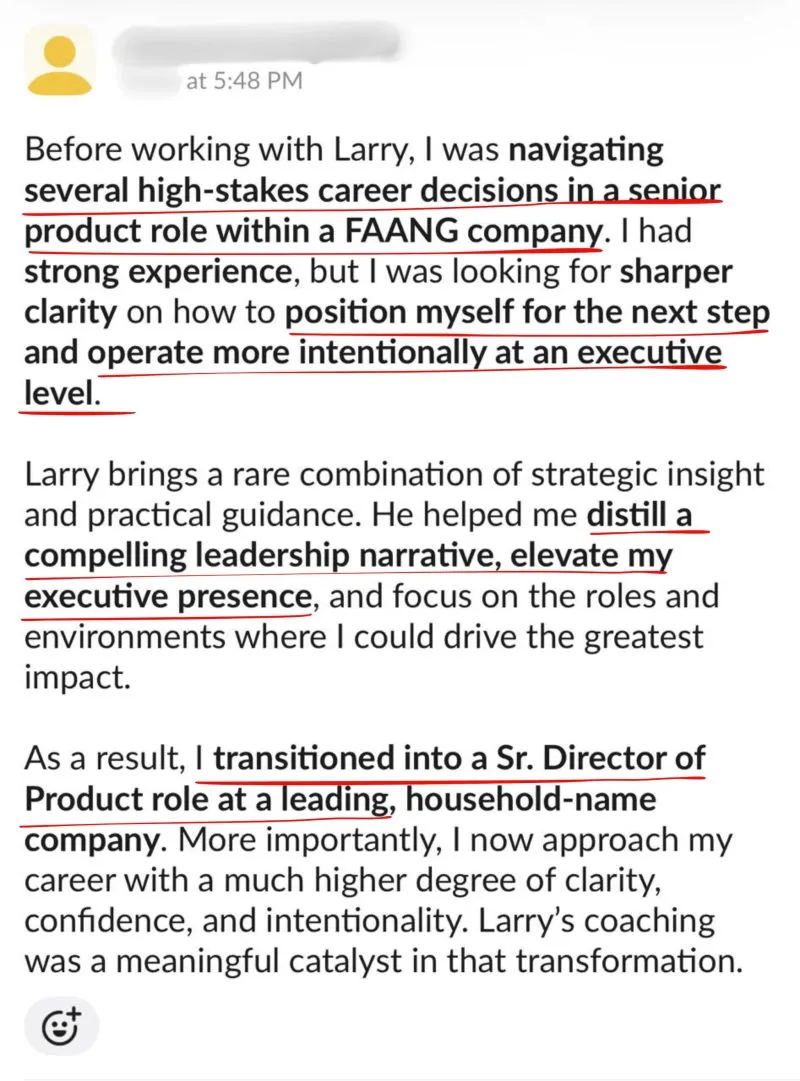
Chris had the kind of career most product leaders would envy. A senior role at a FAANG company.
But when it came to figuring out his next move, he realized something uncomfortable: he could not see himself clearly enough to position what he actually brought to the table.
And that is the part that surprises people. Chris was not a junior. He was not early in his career. He had a strong resume, real results, and years of experience leading at scale.
What happens when you spend years inside one company
Your value becomes invisible to you because everyone around you already understands it.
Your manager knows what you built. Your team knows how you think. The stakeholders know what you bring to a room. And you stop needing to explain yourself because the context does it for you.
Then you step outside that environment, and all of that context disappears overnight.
Suddenly, you’re sitting across from someone who has never seen your work, never watched you lead a team through a hard quarter, never seen how you handle ambiguity.
And you’re expected to communicate all of that in a 45-minute conversation or a two-page resume.
Most senior ICs and new leaders are not prepared for how different that feels. And it doesn’t happen because they lack substance — it happens because they’ve never had to package the substance before.
What I’ve seen from the hiring side
I’ve been on the hiring side for almost two decades. I’ve made the calls on who gets the offer and who does not.
And I can tell you that the gap between candidates who land and candidates who stall is almost never about qualifications. It’s about how clearly someone can communicate the value they have already created.
Chris didn’t need to become a different professional. He needed to learn how to communicate the one he already was.
Once we worked on that together, the shift was clear. He stopped underselling himself by defaulting to a list of projects, and started framing decisions, trade-offs, and outcomes in a way that made evaluators understand his judgment, not just his output.
If you are a senior product, engineering, or technical leader at a point where your next move needs to be more intentional than your last one — that’s exactly the kind of conversation I have with clients every week. Read about landing the right next role, or contact me or schedule a discovery call.